AI work, cross-examined.
Version control for AI judgment. AIs that did not write the work take it apart in writing and have to agree. You sign what survives. Who checked what, and who signed, is kept.
A Claude Code plugin that works inside the tool your AI already works in. Nothing moves. The guards run in the background from the first minute; the window is there when you want to watch, and optional. It runs on your machines, through your own accounts with the AI providers. Cadenza hosts nothing.
AI makes mistakes confidently.
Its wrong answer sounds exactly like its right one, so the checking quietly lands back on you. Asking the same AI to check itself does not help: it has the same blind spots the second time. The check has to come from an AI that did not write the work.
Aviation did not get safe by hiring better pilots. It got safe by making the cross-check mandatory, and the captain still commands the aircraft.
Guards that are always on, a check when you ask, and your sign-off.
Guards, always on.
Small rules inside the tool your AI works in, from the first minute. They catch “done” before it is true.
A check, when you ask.
Separately started AIs take the work apart in writing and have to agree before it moves on. Every word is kept in your repository.
Your sign-off.
Nothing ships without it, and no AI can give it. Watch every round, or walk away and come back to the record.
“Verified. Ship it.” The most expensive sentence in AI work.
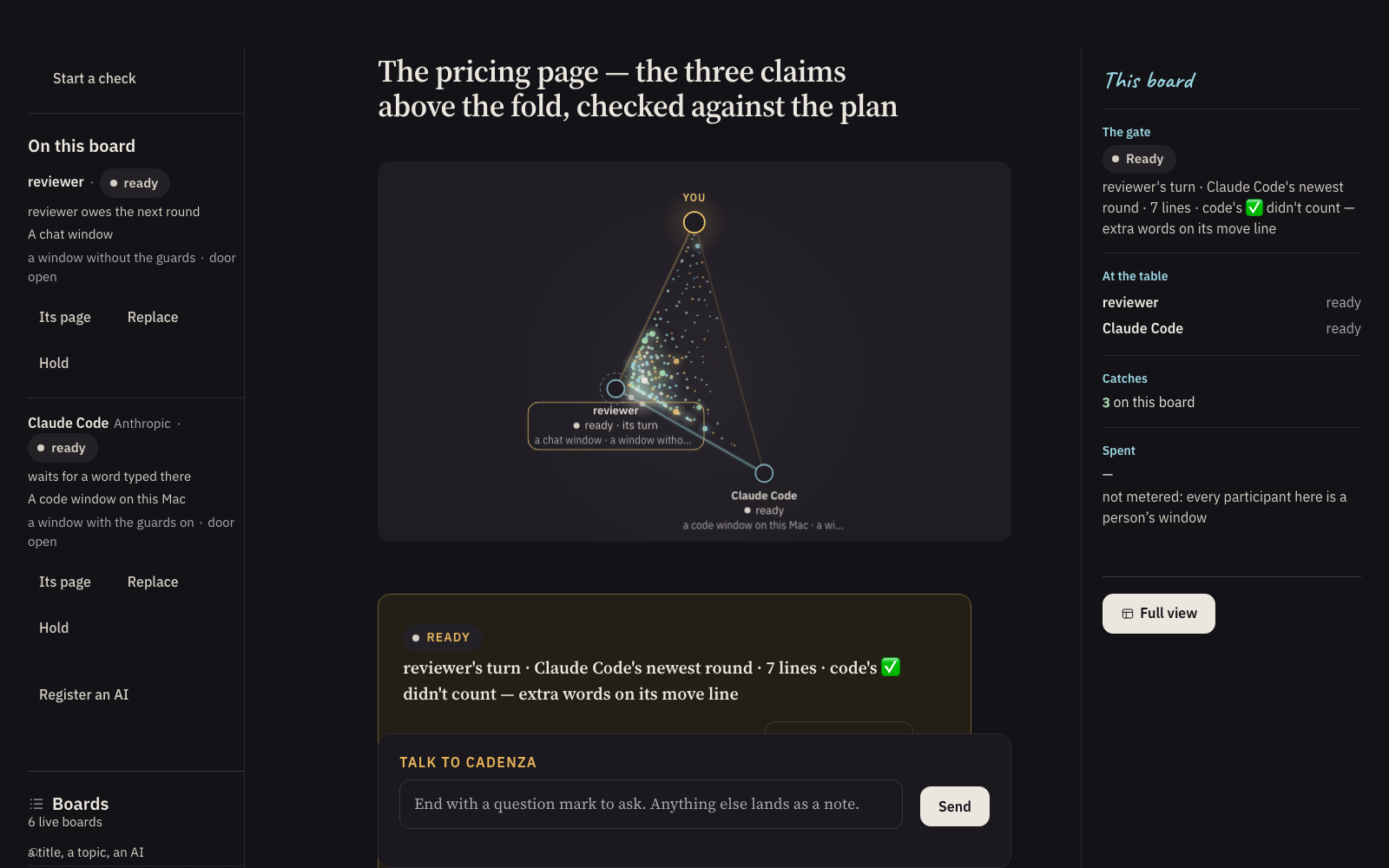
This is the window where that sentence meets a second AI. Open it on six made-up boards: the rounds, every catch and what it would have cost, and the place where you sign. The window is optional: a way to watch and to sign. The work itself stays where it already happens.
You don’t write the rulebook. The catches do.
Rulebooks and guardrails start by asking you to write the rules your AI must follow. That is a blacklist: it catches the mistakes someone already knew to list, and everything else goes through.
Cadenza starts from the other end. Nothing counts until an AI that did not write the work has tried to break it and you have signed, so it catches the mistakes nobody has seen yet. Your context and your rules still go in. Every catch is written down, and a mistake that repeats becomes a rule, so the rulebook grows from your own work, not from more homework.
A blacklist catches the mistakes you already know about. Cadenza catches the ones you don’t.
For work someone will have to answer for.
Any team using AI on work where a mistake is expensive and someone will be asked who checked it: law firms, banks and funds, pharma and the teams that run their trials, audit firms, safety-critical engineering, and software teams shipping what their agents write.
A court filing
In February 2026 one appeals court counted 239 cases of lawyers filing citations that did not exist. Under Cadenza an AI that did not write the draft takes it apart before it leaves.
A clinical trial
A protocol states the dose two ways, once in the text and once in the schedule. Under Cadenza the AIs read the two against each other before it leaves.
A codebase
An agent says the tests pass. It merges only when an AI that did not write the change has tried to break it, and you have signed.
Built by a quant, on his own trading code.
Meir Alelov is a quant who builds and trades systematic strategies. He studied neuroscience and worked as an AI engineer on in-house models before that. For years his algorithm made money on his own account, almost every day. When he began scaling it with AI writing the code, one AI checking its own work let mistakes through that only he caught, by hand. Cadenza is what he built to be sure. He has worked no other way since, including on Cadenza itself.